Blog
MCP Servers: Bridging AI Models with Enterprise Systems
The Future of AI System Integration

On this page
The Model Context Protocol (MCP) represents a paradigm shift in how AI models interact with enterprise systems. As organizations increasingly adopt AI, the need for standardized, secure, and scalable integration methods has never been more critical.
🚀 What are MCP Servers?
MCP Servers act as intermediaries between AI models (like Claude, GPT-4, or custom LLMs) and your enterprise systems. They provide a standardized protocol for:
- Context Management: Maintaining conversation context and state across multiple interactions
- Tool Integration: Exposing enterprise APIs, databases, and services to AI models in a secure manner
- Resource Access: Controlled access to files, documents, and data repositories
- Authentication & Authorization: Enterprise-grade security for AI interactions
- Observability: Full audit trails and monitoring of AI system interactions
🏗️ MCP Architecture
The MCP architecture consists of three main components:
1. MCP Client (AI Model)
The AI model (Claude, GPT-4, etc.) acts as the client, making requests through the MCP protocol to access tools and resources.
2. MCP Server
The server implements the MCP protocol and exposes:
- Tools: Functions the AI can call (e.g., database queries, API calls)
- Resources: Files, documents, and data the AI can access
- Prompts: Pre-defined templates for common tasks
3. Enterprise Systems
Your existing infrastructure: databases, APIs, file systems, SaaS applications, and internal tools.
💡 Key Benefits of MCP Servers
1. Standardization
MCP provides a universal protocol for AI-system integration, reducing development time by 60-70% compared to custom implementations.
2. Security
Built-in authentication, authorization, and audit logging ensure enterprise-grade security. All AI interactions are logged and can be monitored in real-time.
3. Scalability
MCP Servers can handle thousands of concurrent AI interactions, with built-in load balancing and failover capabilities.
4. Flexibility
Support for multiple AI models simultaneously - use Claude for analysis, GPT-4 for generation, and custom models for specialized tasks.
🔧 Implementation Example
Here's a simple example of implementing an MCP Server for database access:
// MCP Server Configuration
const mcpServer = new MCPServer({
  name: 'enterprise-db-server',
  version: '1.0.0',
  tools: [
    {
      name: 'query_customer_data',
      description: 'Query customer information from the database',
      parameters: {
        customerId: 'string',
        fields: 'array'
      },
      handler: async (params) => {
        // Secure database query with authentication
        const result = await db.query(
          'SELECT * FROM customers WHERE id = ?',
          [params.customerId]
        );
        return result;
      }
    }
  ],
  authentication: {
    type: 'oauth2',
    provider: 'enterprise-sso'
  },
  rateLimit: {
    requestsPerMinute: 100,
    burstSize: 20
  }
});

mcpServer.listen(8080);
🎯 Real-World Use Cases
1. Customer Support Automation
MCP Servers enable AI assistants to:
- Query CRM systems for customer history
- Access support ticket databases
- Update customer records
- Generate reports and analytics
Result: 70% reduction in average handling time, 95% accuracy in information retrieval.
2. DevOps & SRE
AI-powered operations with MCP:
- Query monitoring systems (Grafana, Prometheus)
- Analyze logs from Elasticsearch
- Execute remediation scripts
- Generate incident reports
Result: 60% faster MTTR, automated resolution of 40% of incidents.
3. Data Analysis & Business Intelligence
Connect AI to your data warehouse:
- Natural language queries to SQL
- Automated report generation
- Anomaly detection across datasets
- Predictive analytics
Result: 80% faster insights, democratized data access across organization.
🔐 Security Best Practices
1. Authentication & Authorization
- Implement OAuth 2.0 or SAML for user authentication
- Use role-based access control (RBAC) for tool access
- Enforce least privilege principle
2. Data Protection
- Encrypt all data in transit (TLS 1.3)
- Implement field-level encryption for sensitive data
- Use tokenization for PII
3. Audit & Monitoring
- Log all AI interactions with full context
- Monitor for unusual patterns or anomalies
- Implement real-time alerting for security events
📊 Performance Metrics
Organizations implementing MCP Servers report:
- 70% faster AI integration compared to custom implementations
- 90% reduction in integration maintenance overhead
- 99.95% uptime with proper HA configuration
- Sub-100ms latency for most tool calls
- Support for 10,000+ concurrent AI sessions
🚀 Getting Started with MCP Servers
Step 1: Define Your Use Case
Identify which enterprise systems need AI integration and what tools the AI should have access to.
Step 2: Choose Your Implementation
Options include:
- Open-source MCP frameworks (TypeScript, Python)
- Enterprise solutions (TenthMatrix, Anthropic Claude)
- Custom implementation using MCP specification
Step 3: Implement Security
Set up authentication, authorization, and audit logging before deploying to production.
Step 4: Test & Monitor
Thoroughly test all tools and monitor AI interactions in production.
Step 5: Scale
Implement load balancing, caching, and optimization for production scale.
🔮 The Future of MCP
The MCP ecosystem is rapidly evolving with:
- Multi-modal support: Images, audio, and video processing
- Federated MCP networks: Organizations sharing tools securely
- AI agent orchestration: Multiple AI agents collaborating via MCP
- Enhanced observability: Full distributed tracing for AI workflows
📚 Resources & Next Steps
- Watch our MCP Server tutorials
- Read the full MCP documentation
- Get expert help with MCP implementation
Ready to transform your AI integration? MCP Servers provide the foundation for scalable, secure, and maintainable AI-powered enterprise systems.
More from the blog
Observability Is Not Optional: Make It a Business Standard
Why fragmented monitoring creates blind spots, duplicate spend, and slow incidents — and how to make centralised observability a non-negotiable company standard.
WSL Vault for Compliance: One Tenant Never Opens Another’s Secrets
How WSL Vault keeps app, team, and environment tenants cryptographically isolated — so a stolen root-style token cannot empty the estate — and why dual-tenant control beats secrets sprawl.
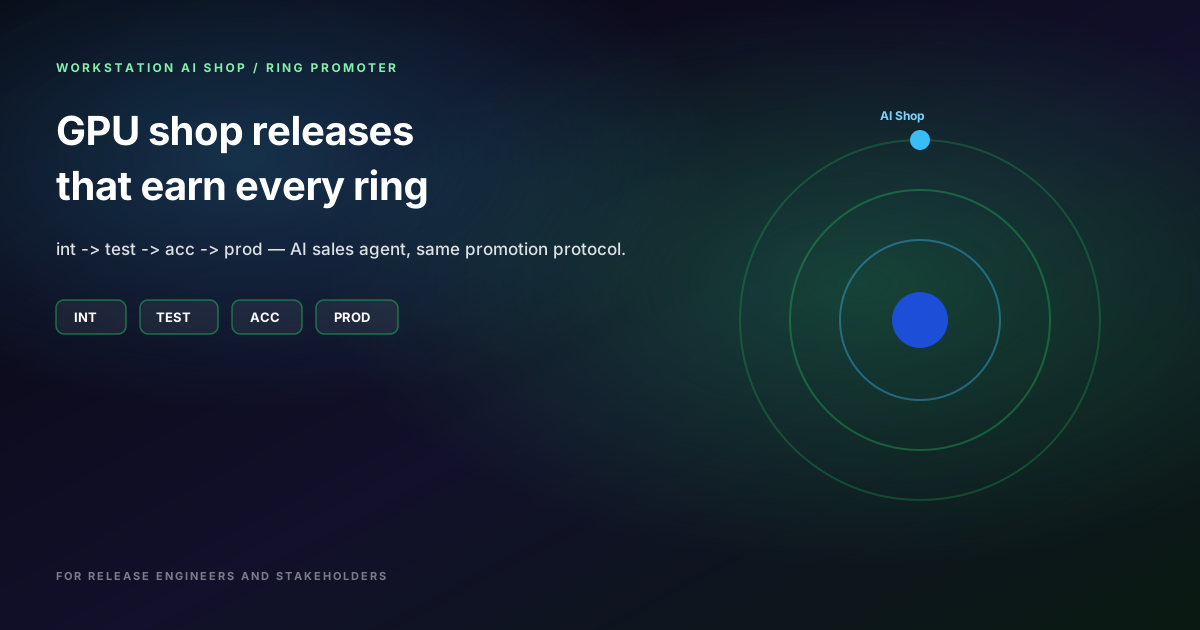
Workstation AI Shop: Promoting the AI Sales Storefront Through int → test → acc → prod
Workstation AI Shop sells GPU machines with a fully autonomous AI Sales Agent that configures the basket. See how Ring Promoter moves each build through int → test → acc → prod — with Orbit screenshots release engineers and stakeholders share.