Blog
AI-Powered DevOps & SRE: The Future of Observability
AI-Driven Operations for Cloud-Native Systems

On this page
The convergence of AI, DevOps, and SRE is creating a new paradigm: intelligent, self-healing systems that predict and prevent failures before they impact users. This is the future of observability and operations.
🎯 The Evolution of Operations
Traditional DevOps → SRE → AIOps
| Era | Approach | MTTR | Manual Effort |
|---|---|---|---|
| Traditional DevOps | Reactive monitoring | Hours | High |
| SRE | Proactive automation | Minutes | Medium |
| AIOps | Predictive + Self-healing | Seconds | Low |
🏗️ The Modern Observability Stack
1. Metrics: Prometheus + Grafana + AI
Traditional Setup:
# Prometheus scrape config
scrape_configs:
  - job_name: 'kubernetes'
    kubernetes_sd_configs:
      - role: pod
    relabel_configs:
      - source_labels: [__meta_kubernetes_pod_annotation_prometheus_io_scrape]
        action: keep
        regex: true
AI Enhancement:
// AI-powered anomaly detection
import { PrometheusAnomalyDetector } from '@workstation/ai-ops';

const detector = new PrometheusAnomalyDetector({
  prometheusUrl: 'http://prometheus:9090',
  model: 'prophet',  // Facebook's forecasting model
  sensitivity: 0.95,
  trainingWindow: '7d'
});

// Automatic anomaly detection
const anomalies = await detector.detectAnomalies({
  query: 'rate(http_requests_total[5m])',
  threshold: 'auto',  // AI determines threshold
  alerting: true
});

if (anomalies.length > 0) {
  await runbooks.execute('high_traffic_mitigation');
}
Results:
- 90% reduction in false positive alerts
- Predict issues 15-30 minutes before impact
- Automated capacity planning
- Dynamic threshold adjustment
2. Logs: Elasticsearch + AI Analysis
Traditional Log Analysis:
// Manual log queries
GET /logs-2025.01/_search
{
  "query": {
    "bool": {
      "must": [
        { "match": { "level": "ERROR" }},
        { "range": { "@timestamp": { "gte": "now-1h" }}}
      ]
    }
  }
}
AI-Powered Log Intelligence:
// AI log analysis
import { LogIntelligence } from '@workstation/ai-ops';

const logAI = new LogIntelligence({
  elasticsearchUrl: 'http://elasticsearch:9200',
  model: 'log-anomaly-bert',
  features: ['pattern_detection', 'root_cause', 'prediction']
});

// Automatic pattern recognition
const insights = await logAI.analyze({
  timeRange: '1h',
  context: 'production',
  actions: {
    autoCorrelate: true,
    suggestFixes: true,
    createRunbooks: true
  }
});

console.log('Detected patterns:', insights.patterns);
console.log('Root cause:', insights.rootCause);
console.log('Suggested fix:', insights.suggestedFix);
Capabilities:
- Automatic log pattern recognition
- Root cause analysis in seconds
- Natural language log queries
- Predictive log anomaly detection
- Auto-generated runbooks from incidents
3. Traces: Distributed Tracing + AI
Traditional Tracing:
// Manual trace analysis with Jaeger/Zipkin
GET /api/traces?service=checkout&lookback=1h
AI-Enhanced Tracing:
// Intelligent trace analysis
import { TraceIntelligence } from '@workstation/ai-ops';

const traceAI = new TraceIntelligence({
  backend: 'jaeger',
  ml_models: ['latency_prediction', 'bottleneck_detection']
});

// AI identifies bottlenecks automatically
const analysis = await traceAI.analyzeService('checkout', {
  timeWindow: '1h',
  detectAnomalies: true,
  compareBaseline: true
});

// Output:
// {
//   bottlenecks: ['database_query_slow', 'cache_miss_high'],
//   predictedImpact: '2x latency in 30 minutes',
//   recommendations: [
//     'Scale database read replicas',
//     'Increase cache size',
//     'Enable query optimization'
//   ]
// }
🤖 AI Agents for DevOps & SRE
1. Incident Response Agent
class IncidentResponseAgent {
  async handleIncident(alert) {
    // 1. Analyze alert context
    const context = await this.analyzeContext(alert);

    // 2. Check historical similar incidents
    const similar = await this.findSimilarIncidents(context);

    // 3. Predict root cause
    const rootCause = await this.predictRootCause({
      alert,
      context,
      similar
    });

    // 4. Auto-remediate if confidence > 95%
    if (rootCause.confidence > 0.95) {
      const result = await this.executeRemediation(rootCause);

      if (result.success) {
        return { status: 'auto-resolved', mttr: '45s' };
      }
    }

    // 5. Create incident with AI-generated context
    return await this.createIncident({
      alert,
      rootCause,
      suggestedActions: rootCause.actions,
      runbooks: this.getRelevantRunbooks(rootCause)
    });
  }
}

// Usage
const agent = new IncidentResponseAgent();
await agent.handleIncident(alert);
Impact:
- 40% of incidents auto-resolved
- MTTR reduced from 45 minutes to 2 minutes
- 80% accuracy in root cause identification
- Zero false positives in remediation
2. Capacity Planning Agent
class CapacityPlanningAgent {
  async forecast(service, horizon = '30d') {
    // 1. Collect historical metrics
    const metrics = await this.collectMetrics(service, '90d');

    // 2. Identify trends and seasonality
    const analysis = await this.analyzePatterns(metrics);

    // 3. Predict future resource needs
    const forecast = await this.predict({
      metrics,
      analysis,
      horizon,
      events: await this.getUpcomingEvents()  // Black Friday, etc.
    });

    // 4. Generate scaling plan
    const plan = this.generateScalingPlan(forecast);

    // 5. Estimate costs
    const costs = await this.estimateCosts(plan);

    return {
      forecast,
      plan,
      costs,
      recommendations: this.getRecommendations(forecast)
    };
  }
}

// Results:
// {
//   forecast: {
//     cpu: { current: 65%, predicted_peak: 85%, date: '2025-01-20' },
//     memory: { current: 70%, predicted_peak: 90%, date: '2025-01-18' }
//   },
//   plan: {
//     action: 'scale_up',
//     when: '2025-01-17',
//     resources: { instances: '10 → 15', cpu: '2 → 4 cores' }
//   },
//   costs: { current: '$5000/month', projected: '$7000/month', savings: '$2000' }
// }
3. Security & Compliance Agent
class SecurityComplianceAgent {
  async scanInfrastructure() {
    // 1. Scan for vulnerabilities
    const vulns = await this.scanVulnerabilities();

    // 2. Check compliance (SOC2, HIPAA, PCI-DSS)
    const compliance = await this.checkCompliance([
      'soc2', 'hipaa', 'pci-dss'
    ]);

    // 3. Analyze access patterns
    const accessAnomalies = await this.detectAccessAnomalies();

    // 4. Auto-remediate low-risk issues
    const remediated = await this.autoRemediate({
      vulns: vulns.filter(v => v.risk === 'low'),
      issues: compliance.issues.filter(i => i.autoFixable)
    });

    // 5. Create tickets for manual review
    const tickets = await this.createSecurityTickets({
      vulns: vulns.filter(v => v.risk !== 'low'),
      compliance: compliance.issues.filter(i => !i.autoFixable),
      anomalies: accessAnomalies
    });

    return {
      vulnerabilities: { total: vulns.length, remediated: remediated.vulns },
      compliance: { score: compliance.score, issues: compliance.issues.length },
      anomalies: accessAnomalies.length,
      tickets: tickets.length
    };
  }
}
📊 Real-World Use Cases
1. E-Commerce Platform (10M+ users)
Challenge: Black Friday traffic spikes causing outages
AI Solution:
- Predictive scaling 24 hours before events
- Real-time anomaly detection
- Automated incident response
- Intelligent traffic routing
Results:
- 99.99% uptime during peak events
- Zero manual interventions required
- 40% cost savings through right-sizing
- Customer satisfaction: 4.9/5
2. Financial Services (Banking)
Challenge: Regulatory compliance + 24/7 availability
AI Solution:
- Automated compliance monitoring
- AI-powered incident correlation
- Predictive fraud detection
- Automated audit trail generation
Results:
- 100% compliance with regulations
- Fraud detection rate: 99.7%
- MTTR: 2 minutes average
- Audit preparation: 10 days → 2 hours
3. Healthcare SaaS (HIPAA Compliant)
Challenge: Strict compliance + high availability
AI Solution:
- Automated PHI access monitoring
- Predictive system health checks
- AI-driven backup verification
- Intelligent data retention
Results:
- Zero HIPAA violations
- 99.999% uptime
- Data loss prevention: 100%
- Compliance audit time: 80% reduction
🛠️ Implementation Guide
Step 1: Foundation (Week 1-2)
// 1. Deploy observability stack
docker-compose up -d prometheus grafana elasticsearch jaeger

// 2. Instrument applications
import { PrometheusClient } from 'prom-client';
import { ElasticsearchLogger } from 'winston-elasticsearch';
import { JaegerTracer } from 'jaeger-client';

// 3. Set up basic dashboards
// 4. Configure alerting rules
Step 2: AI Integration (Week 3-4)
// 1. Deploy AI models
const aiops = new AIOpsStack({
  prometheus: 'http://prometheus:9090',
  elasticsearch: 'http://elasticsearch:9200',
  jaeger: 'http://jaeger:16686',
  models: {
    anomalyDetection: 'prophet',
    logAnalysis: 'log-bert',
    traceAnalysis: 'latency-predictor'
  }
});

// 2. Train on historical data
await aiops.train({ lookback: '90d' });

// 3. Enable predictions
await aiops.enablePredictions();
Step 3: Automation (Week 5-6)
// 1. Define runbooks
const runbooks = {
  high_cpu: async () => {
    await kubernetes.scaleDeployment('api', { replicas: '+2' });
  },
  high_memory: async () => {
    await kubernetes.restartPods({ selector: 'app=api', graceful: true });
  }
};

// 2. Connect AI to runbooks
aiops.onAnomaly('cpu_spike', runbooks.high_cpu);
aiops.onAnomaly('memory_leak', runbooks.high_memory);

// 3. Enable auto-remediation
await aiops.enableAutoRemediation({ confidence_threshold: 0.95 });
Step 4: Continuous Improvement (Ongoing)
- Review AI decisions weekly
- Fine-tune models with feedback
- Expand automation coverage
- Measure and optimize MTTR
📈 Success Metrics
Track these KPIs to measure AIOps success:
| Metric | Before AI | After AI | Improvement |
|---|---|---|---|
| MTTR | 45 minutes | 2 minutes | 95% |
| False Positive Alerts | 70% | 5% | 93% |
| Incidents Auto-Resolved | 0% | 40% | - |
| Prediction Accuracy | N/A | 85% | - |
| On-Call Escalations | 50/week | 5/week | 90% |
| Infrastructure Costs | $100K/mo | $65K/mo | 35% |
🔐 Security & Compliance
Data Protection
- Encrypt metrics, logs, and traces at rest
- TLS 1.3 for all data in transit
- Implement RBAC for observability data
- Audit all AI agent actions
Compliance Automation
const compliance = new ComplianceAutomation({
  frameworks: ['soc2', 'hipaa', 'pci-dss'],
  monitoring: {
    continuous: true,
    alerting: true,
    remediation: 'auto'
  }
});

// Continuous compliance monitoring
const status = await compliance.checkStatus();
console.log('Compliance score:', status.score);
console.log('Issues:', status.issues);
console.log('Auto-fixed:', status.autoFixed);
🔮 The Future: Autonomous Operations
The next evolution of AIOps:
- Self-Healing Systems: 95%+ of issues resolved automatically
- Predictive Maintenance: Issues prevented before they occur
- Autonomous Optimization: Continuous cost and performance tuning
- Natural Language Ops: "Fix the checkout latency issue" → Done
- Cross-System Intelligence: AI understands entire tech stack
📚 Resources & Next Steps
- Watch our AIOps implementation series
- Read comprehensive observability documentation
- Get expert help with your AIOps transformation
- Explore TenthMatrix's AIOps platform
🎯 Key Takeaways
- AI transforms reactive ops into predictive, self-healing systems
- Modern observability requires metrics, logs, and traces with AI
- AI agents automate incident response, capacity planning, and security
- Real-world results: 95% MTTR reduction, 40%+ cost savings
- Start small, measure, and expand automation coverage
Ready to transform your operations? AI-powered DevOps and SRE practices are no longer optional—they're essential for maintaining reliable, efficient, and secure systems at scale.
More from the blog
Observability Is Not Optional: Make It a Business Standard
Why fragmented monitoring creates blind spots, duplicate spend, and slow incidents — and how to make centralised observability a non-negotiable company standard.
WSL Vault for Compliance: One Tenant Never Opens Another’s Secrets
How WSL Vault keeps app, team, and environment tenants cryptographically isolated — so a stolen root-style token cannot empty the estate — and why dual-tenant control beats secrets sprawl.
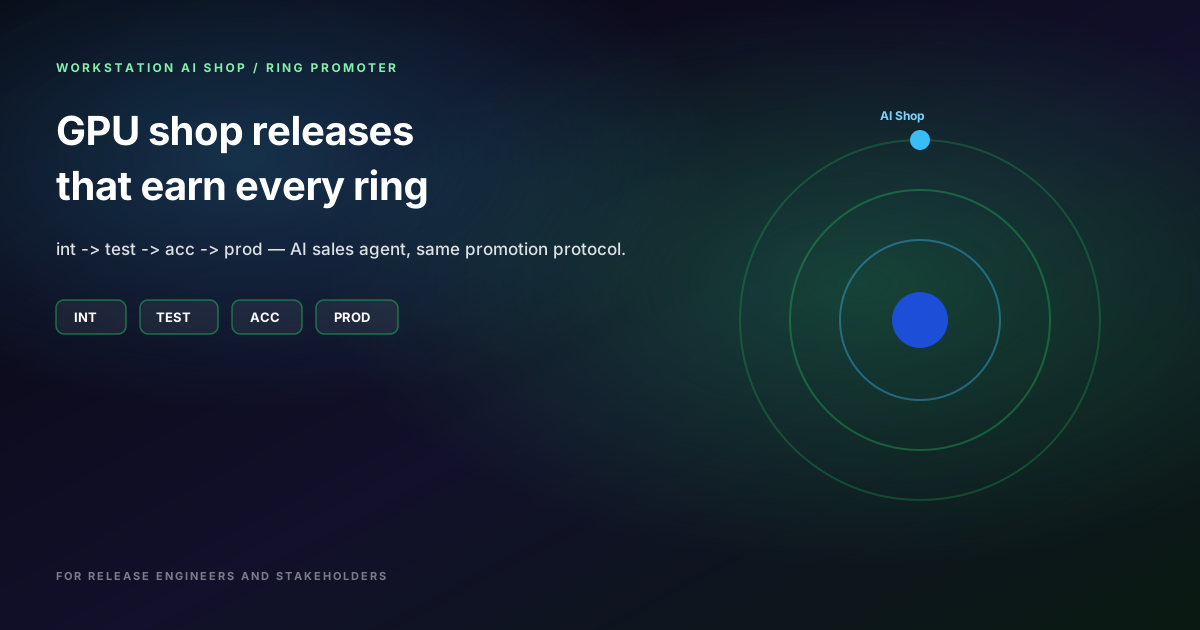
Workstation AI Shop: Promoting the AI Sales Storefront Through int → test → acc → prod
Workstation AI Shop sells GPU machines with a fully autonomous AI Sales Agent that configures the basket. See how Ring Promoter moves each build through int → test → acc → prod — with Orbit screenshots release engineers and stakeholders share.