Блог
NVIDIA Nemotron 3.5 Lightning on Ollama: Fast Local AI Agents That Keep Your Data In-House
What NVIDIA's open 30B model with 3B active parameters means for businesses running AI agents, what it costs to run and where it fits alongside the cloud
На этой странице
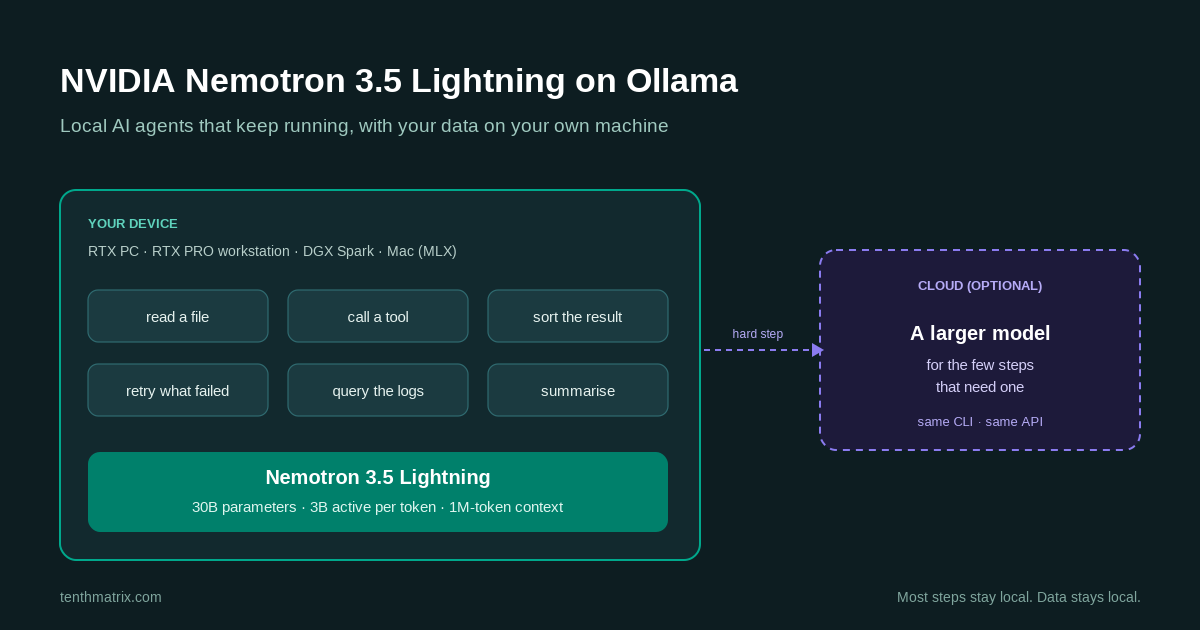
Most of the work an AI agent does is not clever. It reads a file, calls a tool, sorts the result, notices that something failed and tries again. Paying a frontier model in the cloud for every one of those small steps is slow, adds up quickly, and sends your data to someone else's servers each time. NVIDIA's Nemotron 3.5 Lightning is built for exactly those steps, and it is now available on Ollama, so it runs on a workstation, a well-specified PC or a Mac on your own desk. This post explains what it is, where it fits in a business, what it costs to run and the questions to ask before adopting it. Developers can go straight to the technical note.
The news in one paragraph
NVIDIA released Nemotron 3.5 Lightning on 11 August 2026, describing it as "an open 30B MoE model with 3B active parameters, built for always-on agents to complete high-volume, specialized tasks faster". Ollama, the most widely used tool for running open models on your own computer, now offers it as nemotron-3.5-lightning, with a version tuned for Apple silicon. Ollama's model page had passed 900,000 downloads when we checked on 20 November 2026. With one command it can also power the coding and assistant tools developers already use, including Claude Code, OpenCode, OpenClaw and Hermes Agent. The same model is available from NVIDIA's own catalogue and from hosted API providers, so you are not tied to one way of running it.
Why a small, fast model matters for agents
An AI agent is a loop. It looks at the task, decides on a step, runs a tool, reads the result and decides again. A single request from a user ("reconcile last month's supplier invoices", "find why the nightly build failed") can turn into dozens or hundreds of model calls. Three things follow:
- Speed compounds. If each step takes three seconds instead of one, a 60-step task takes three minutes instead of one. People stop waiting for agents that feel slow, so they stop using them.
- Cost compounds. Every step re-sends the growing conversation. Per-token cloud pricing that looks trivial for one question becomes a real line item for an agent that runs all day.
- Data exposure compounds. Every step that goes to a cloud API carries whatever the agent has read: emails, contracts, log lines, customer records.
Most of those steps do not need the largest model available. Choosing which file to open next, pulling fields out of an invoice or deciding whether a test passed is routine. NVIDIA's own advice is to "use frontier models for complex reasoning and planning, and Lightning for high-volume, specialized execution". That is the design idea behind Lightning, and it matches what we see in our own agent work.
What is new about Nemotron 3.5 Lightning
30 billion parameters, 3 billion at work
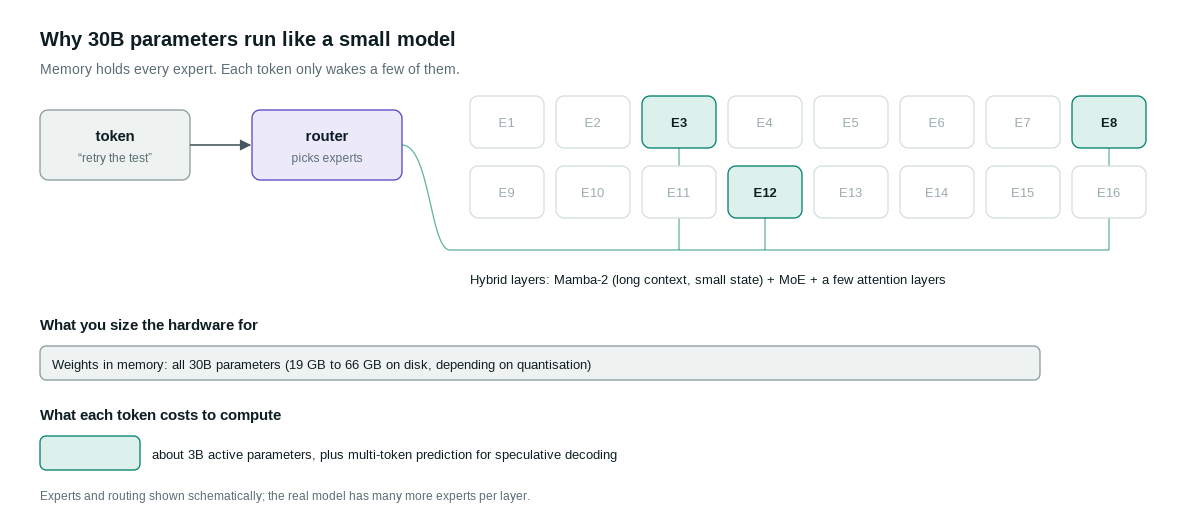
Lightning is a mixture-of-experts model. Think of it as a team of specialists with a dispatcher: for each word it writes, the dispatcher sends the work to a handful of specialists and the rest sit idle. The model holds 30 billion parameters, so it knows a lot, but only about 3 billion are computed for each word, so it runs at roughly the speed of a much smaller model. You still need enough memory to hold the whole model; you just do far less arithmetic per word.
A hybrid design built for long tasks
NVIDIA combines three kinds of layer: Mamba-2 layers, which handle long inputs efficiently, mixture-of-experts layers, and a small number of the attention layers most language models are built from. The practical result is a context window of up to one million tokens, roughly a few thousand pages of text, and a model that keeps responding well as an agent's working memory grows. On Apple silicon the Ollama build offers up to 256,000 tokens.
Faster answers through speculative decoding
Lightning is trained to predict several words at a time, and it ships with speculative decoding methods (multi-token prediction, DFlash and DSpark) that let it produce text in bursts instead of one word at a time. NVIDIA reports up to 4x the output speed of comparable open models, and Ollama's model page quotes 30% lower task completion time against other leading open models of a similar size. Those are vendor figures. Test them on your own tasks before you plan around them.
Trained for the tools you already use
NVIDIA developed Lightning with the Nemotron Coalition and trained it for coding, tool calling, following instructions and multi-turn work inside agent harnesses. NVIDIA built it by distilling knowledge from its larger Nemotron 3 Super model, then trained it further for long context and agent tasks.
Open, and yours to specialise
The weights are published and NVIDIA describes the training data and recipes openly. The OpenMDW 1.1 licence permits commercial use under its terms. That means you can take Lightning and train it further for one narrow job (classifying your support tickets, reading your industry's documents, following your internal procedures) and run the result wherever you like. As with any licence, have someone read it before you build a product on it.
Where it fits in a business
1. Long-running personal and team assistants
Email triage, calendar juggling, project updates, travel and bookings. These agents run all day and touch some of the most sensitive information a business has. Running the model locally means the assistant can use local context (the files, mailboxes and notes it has been given access to) without any of it being sent elsewhere.
2. Coding sub-agents
Running the test suite, searching the codebase, renaming a function across fifty files, reading a stack trace. In a typical coding session, these chores far outnumber the moments that need deep design thinking. A local model handles them inside the tools your developers already use, so source code stays on the developer's machine, and the larger cloud model is kept for planning and hard debugging.
3. Security operations
Enriching alerts, classifying incidents, querying logs, correlating indicators of compromise and preparing structured findings for an analyst. Security data is exactly the kind you would rather not send to a third party, and the work is high-volume and repetitive. A local agent can do the first pass on every alert, at any hour, and hand the analyst a tidy summary.
4. Document-heavy back-office work
NVIDIA and Ollama both point to financial services, telecoms and retail: extracting data from documents, checking policy rules, monitoring risk signals, triaging network alarms, resolving inventory and fulfilment exceptions, and answering order, return and billing questions. The pattern is the same each time: many small, well-defined steps with clear right answers.
5. A specialist you train yourself
Because the weights and datasets are open, a business with a narrow, valuable task can post-train Lightning on its own examples. A small specialist that does one job very well, runs on a single machine and belongs to you is often a better asset than a general model you rent by the token.
A local tier alongside the cloud
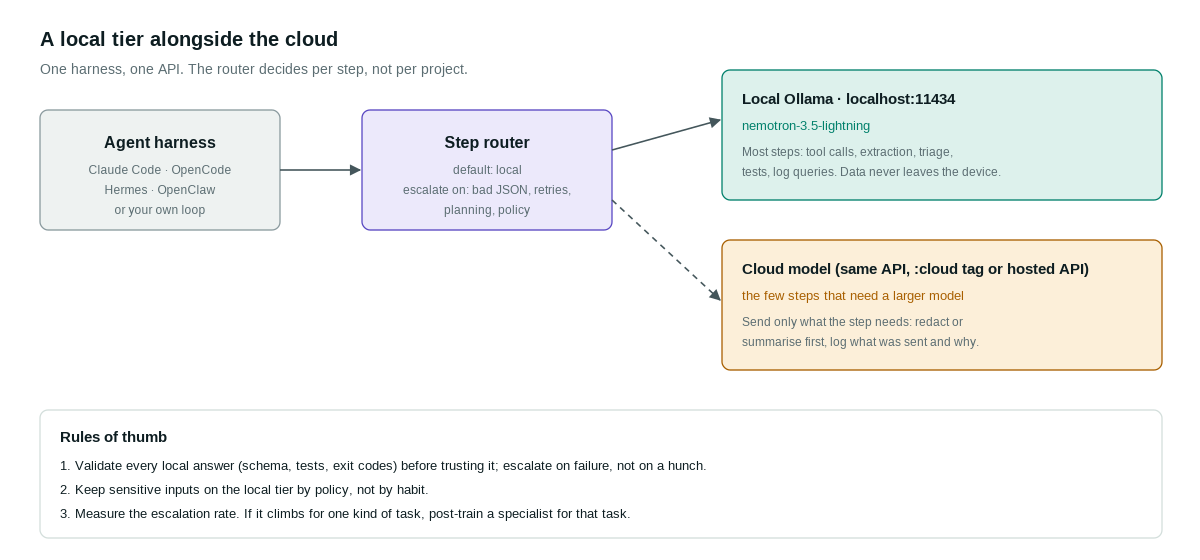
The choice is not "local or cloud". The strongest set-up is both: Lightning handles the high-volume steps on your own hardware, and a larger hosted model picks up the few that need one. Ollama makes this easier because its cloud models use the same command line and the same API as local ones, so an agent can send one step to a bigger model without changing anything else. For a business, that means:
- Predictable costs. The bulk of the work runs on hardware you have already bought, so a busy month does not mean a surprise bill.
- Data stays home by default. Only the steps you choose to escalate leave the building, and you can redact or summarise them first.
- Resilience. If a cloud provider has an outage, changes its prices or retires a model, the local tier keeps working.
- Room to grow. Start with the cloud doing most of the work, measure which steps Lightning handles reliably, and move them across one by one.
What it costs to run
The model is free to download. The cost is the hardware and the electricity. The default Ollama download is about 19 to 25 GB, and the full-precision version is 66 GB, so as a rough guide:
| Machine | Fit for Lightning | Good for |
|---|---|---|
| PC with an NVIDIA RTX card with 32 GB of graphics memory | Comfortable with the standard 4-bit version | One developer or analyst, a personal assistant |
| PC with a 24 GB RTX card | Tight: works, but part of the model may run on the CPU and slow down | Trials and light use |
| NVIDIA RTX PRO workstation or DGX Spark | Plenty of room for higher precision and long context | A team's shared agent server, security operations |
| Mac with Apple silicon and 32 GB or more of unified memory (48 GB or more is better) | Good with the MLX version (about 19 GB) | Developers, consultants, private assistants |
Long contexts use extra memory on top of the model itself, so leave headroom. If you are choosing hardware, our sponsor Workstation builds and supplies NVIDIA RTX and RTX PRO machines in the UK.
For the business case, compare three numbers over a year: the hardware cost spread over its working life, the cloud spend it replaces (count every agent step, not just the user's questions), and the value of keeping sensitive data in-house. For teams running agents continuously, the local tier often pays for itself; for occasional use, the cloud alone may still be cheaper. Measure before you buy.
What it does not do
- It is not a frontier model. For hard planning, ambiguous judgement calls and the most difficult code, a larger model will still do better. Lightning is designed to work alongside one, not to replace it.
- It reads text only. The Ollama versions take text in and give text out. For images, audio or video, NVIDIA offers other Nemotron models.
- Local does not mean safe by default. An agent with access to your files and tools can still be tricked by a malicious email or web page. Running the model locally protects your data from the model provider; it does not protect you from the agent. Sandbox agents, limit their permissions and log what they do. Our post on OpenShell and agent runtime security covers how.
- Benchmarks are not your workload. Treat the speed and accuracy figures as a reason to test, not a promise.
Questions to ask before you adopt it
- Which agent steps do we run most often, and how many are routine? List them. Those are Lightning's job.
- Which data must never leave our machines? Write it down as a policy, so the agent's routing follows a rule rather than habit.
- How will we know when the small model got it wrong? Agents should check results (tests pass, the output matches a schema, the numbers reconcile) and escalate on failure.
- Who owns the hardware and the updates? A local model is software you run. Someone needs to update it, watch it and secure it.
- Has someone read the licence? OpenMDW 1.1 is permissive, but your legal team should confirm it fits your use.
How to get started
A pilot takes an afternoon. Install Ollama, run ollama run nemotron-3.5-lightning, and try it on a task your team does every day. If your developers use Claude Code or OpenCode, ollama launch claude --model nemotron-3.5-lightning points Claude Code at the local model. On a Mac, use the nemotron-3.5-lightning:30b-mlx version. Then pick one real workflow, measure how often the local model gets each step right, and decide which steps to keep local. Our developer guide covers hardware sizing, tool calling, structured output, local-and-cloud routing, security and benchmarking in detail, and our earlier post on private AI with local open-source models covers the wider case for keeping AI in-house.
How TenthMatrix can help
We build AI agents, AI tools and the infrastructure that runs them, and we run local models alongside cloud models in our own work. If you want to know which of your workflows could move to a local tier, what hardware you would need and how to keep the agents safe, talk to us.
Sources: NVIDIA's model card and launch announcement (11 August 2026), the NVIDIA Nemotron 3.5 research page, Ollama's model page and announcement, read on 20 November 2026. Speed figures are the vendors' own. Nemotron and RTX are trademarks of NVIDIA; Ollama is a trademark of its owners. TenthMatrix is not affiliated with either.
Ещё из блога
AI for Tax and VAT Returns: MTD Software for UK Accountancy Firms
How AI agents prepare Income Tax and VAT returns under Making Tax Digital, what an accountancy firm needs from HMRC from sandbox to production (penetration testing included), and the real cost of the AI: hosted, rented private GPUs or bought outright.
One API for Every Product: How OpsAPI Handles Sign-In, Workspaces and Business Modules
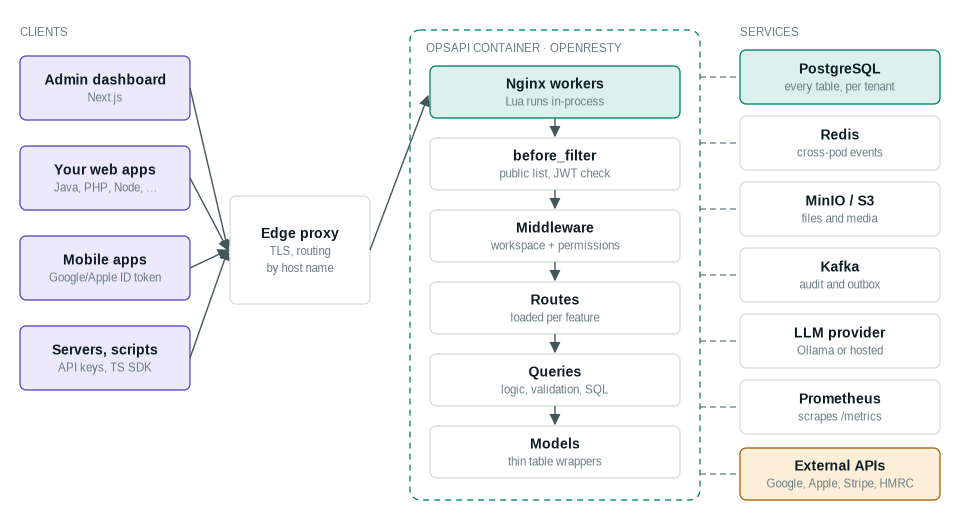
OpsAPI is a self-hosted API that signs users in once for every app, keeps each customer in its own workspace and switches on only the business modules a product needs. How it works, with diagrams and workflows.
OpenShell Joins the CNCF: Why AI Agent Safety Starts at the Runtime
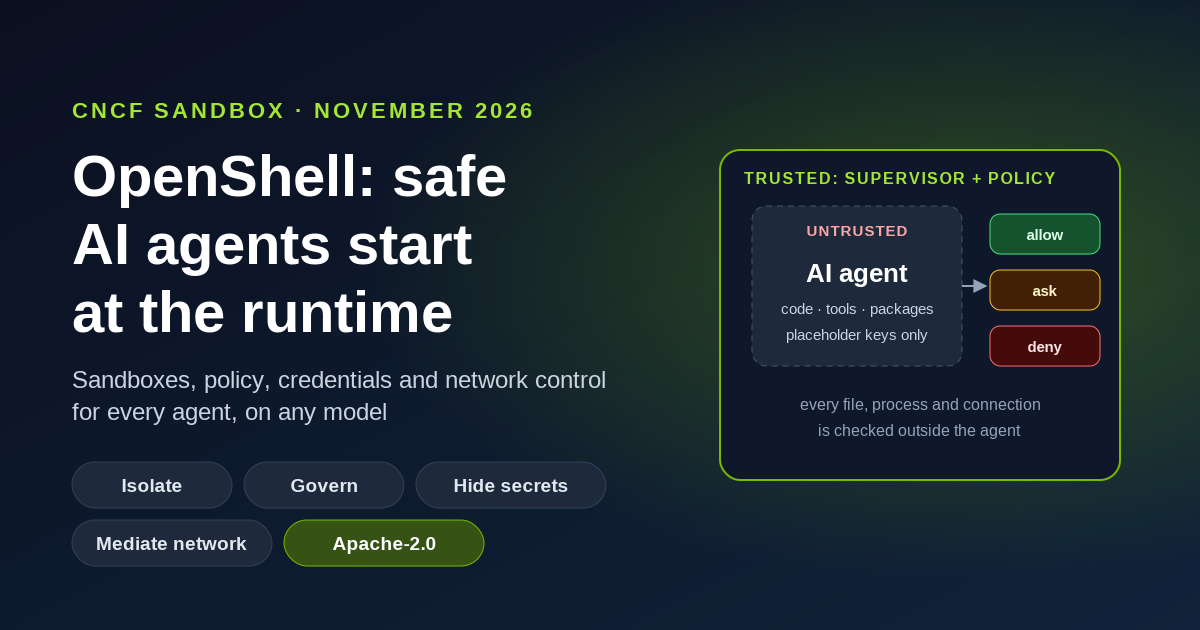
OpenShell, the secure runtime for AI agents created by NVIDIA, is now a CNCF Sandbox project. What it does in plain English, why runtime controls beat prompt instructions, the business benefits, and how TenthMatrix runs its own agents inside it every day.