Fixloop
Open-source AI code review that closes the bug loop.
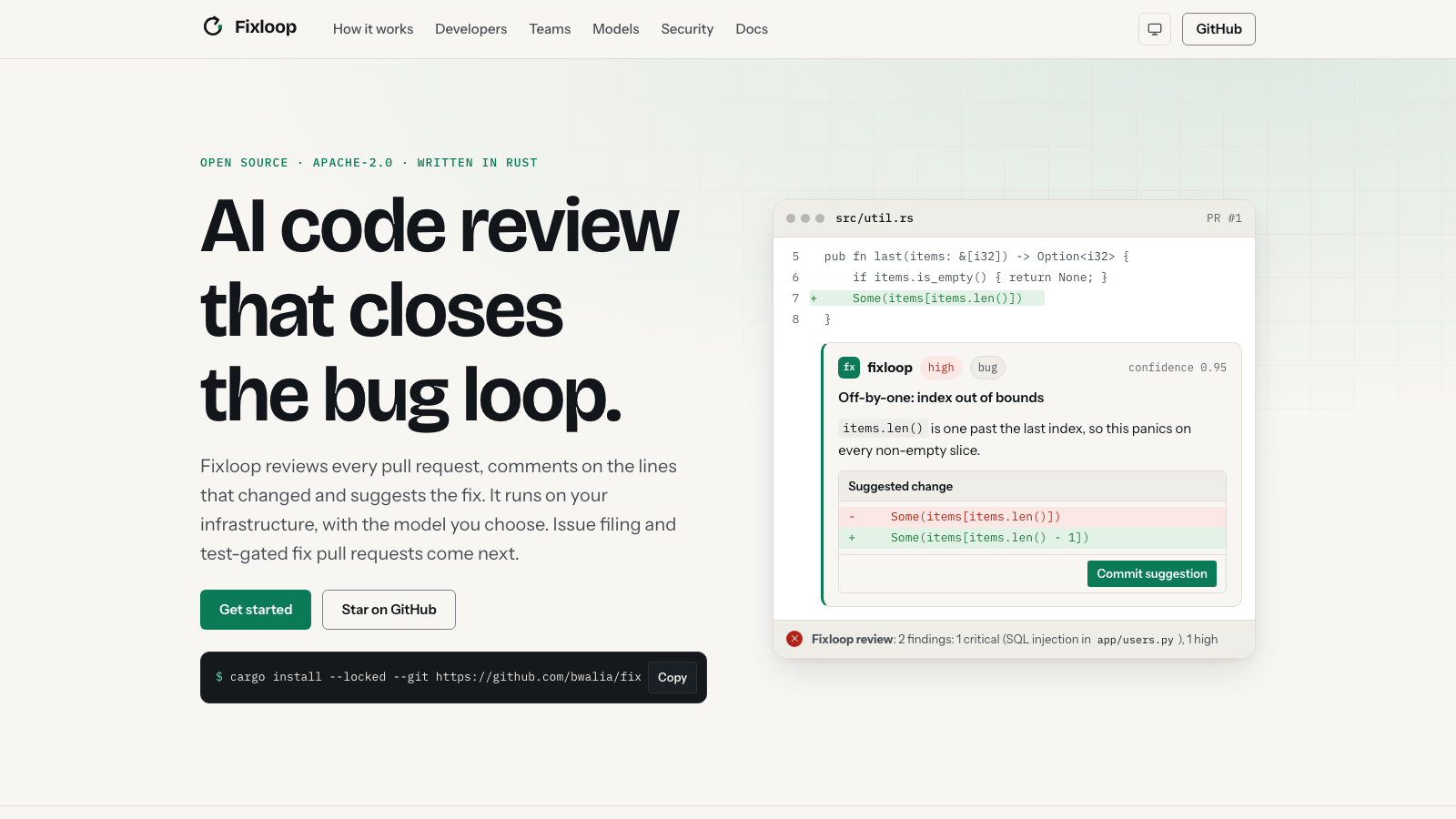
Fixloop reviews every pull request, comments on the lines that changed and suggests the fix. It runs on your infrastructure, with the model you choose. Issue filing and test-gated fix pull requests come next.
One agent, from bug to fix
Most AI review tools stop at a comment. Fixloop is built to carry a bug the whole way: review the pull request, find the problem, file it as an issue, write the fix in a sandbox, check that build, tests and lint pass, then close the issue when the fix is merged. It is open source (Apache-2.0), written in Rust and vendor-neutral. Today it reviews and finds; each next stage ships as its own release.
A review comment on the line that changed
Who it is for
Developers
Comments on your changed lines with a suggested fix, and fixloop review checks your branch before you push. Nothing is posted until you want it.
Engineering leads
A pass, warn or fail check on every pull request, so problems are caught before a human reviewer spends time on them.
Security teams
Secrets are redacted before any model call, a committed secret is a critical finding, and a pull request cannot change its own review rules.
Teams with private code
Self-host it, and mark a repository local-only so its code is only ever sent to models you run yourself.
Review → Find → File → Fix → Check → Close
Review (available)
On every opened or updated pull request, or when someone comments /fixloop review.
Find (available)
Bugs, security issues and broken team rules, on the changed lines only.
File (next)
Open an issue in GitHub Issues or Jira, without duplicates.
Fix (planned)
Write the fix in a sandbox: Docker or Podman, Kubernetes Jobs, or NVIDIA OpenShell.
Check (planned)
Build, tests, lint and a second AI review must all pass before a fix pull request opens.
Close (planned)
Link the fix, close the issue when it merges, and record what it cost.
What it does today
Comments on the lines you changed
Each finding sits on the changed line, with a severity, a confidence score and a suggested fix you can commit in one click.
Review before you push
Run fixloop review in your repository. It checks your branch against main and prints the findings. Nothing is posted.
Your rules, in plain words
Write team conventions as short Markdown files in .fixloop/rules. Every review checks against them.
Quiet by default
Findings below your confidence or severity threshold are dropped. No style nits unless you ask for them.
Spend you can cap
Token and dollar budgets per job and per day. The cost of every review is recorded.
Any model, with fallback
Claude, OpenAI, Gemini, OpenRouter, Azure OpenAI, or local models through Ollama, vLLM, llama.cpp, LM Studio and NVIDIA NIM. If the first model is down, the next one takes over.
Safe on untrusted code
Pull requests are untrusted input. Fixloop is designed with that in mind.
- Keys and tokens in a diff are redacted before any model call, and a committed secret is reported as a critical finding.
- Settings and rules are read from the base branch, never from the pull request, so a pull request cannot weaken its own review.
- Code, comments and pull request text go to the model as data, never as instructions. Output is sanitised before it is posted.
- The GitHub App reads code and writes reviews and checks, nothing else. Only people with write access can run its commands.
- It runs code only in sandboxes, never pushes to your default branch and never merges on its own.
Built in the open, one stage at a time
Fixloop is in early development and not yet ready for production. Progress is tracked publicly on GitHub.
Done
Model layer
Any provider, routing, fallback and budgets.
Done
Reviewer
GitHub App, inline reviews and check runs.
Next
Issue filing
GitHub Issues and Jira, with dedupe and two-way links.
Planned
Fixer
Sandboxed, test-gated fix pull requests.
Planned
Dashboard
Findings, costs and audit in one place.
Planned
Cloud native
Helm, an operator, signed multi-arch images and an SBOM.
Reviewing your first pull request in about 15 minutes
Install the fixloop CLI with Cargo, run fixloop init in your repository, pick a model (hosted, or local with Ollama), then connect GitHub with fixloop github create-app. The getting started guide has every command.
The product site
How it works, model set-up, security and the full roadmap.
Put a reviewer on every pull request
Fixloop is free and open source. Try it on your own repositories, or talk to TenthMatrix about running it for your team with your models and your rules.